
As a master’s student in the Kozakiewicz lab at Kellogg Biological Station, I study snake fungus—more specifically, a fungal disease that affects snakes and poses a potential threat to endangered and threatened species worldwide. Snakes are often misunderstood, seen as slimy or sinister, but they are fascinating and important members of their ecosystems. Fungi face similar misconceptions, often associated with decay and uncleanliness, yet they too are essential—and even charming. Inspired to share this perspective, I teamed up with Ms. Janelle Holland at Gull Lake Community Schools Kellogg Elementary to bring a playful, fungi-themed lesson to her 2nd graders.
Learning is Fun(gus)!
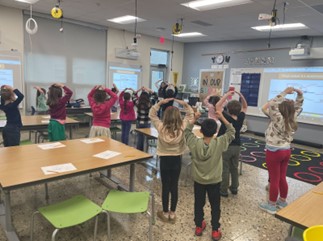
A classroom of 2nd grade students being led by fellow, Hannah Rothkopf to pose as a mushroom.
Our fungi adventure began with a simple question: what is a fungus? We explored how fungi act as decomposers, recycling nutrients back into ecosystems. Because fungi come in so many forms, we examined real specimens—shiitake mushrooms from the grocery store. Some students thought they looked like plants, while others found them completely unfamiliar.
To help us recognize fungi in the wild, we identified parts of a mushroom: cap, gills, and stem—together forming the “fruiting body,” which spreads spores. To make this memorable, we created a wiggly mushroom dance, assigning movements to each part. The students fully embraced it, embodying growing mushrooms with enthusiasm.
We then set up a shiitake grow kit and made predictions about what would happen over the next few weeks. Students observed, watered, and cared for the mushrooms, watching decomposition and growth unfold in real time. By the end, they weren’t just learning about fungi—they were thinking like mycologists: observing, questioning, and predicting.
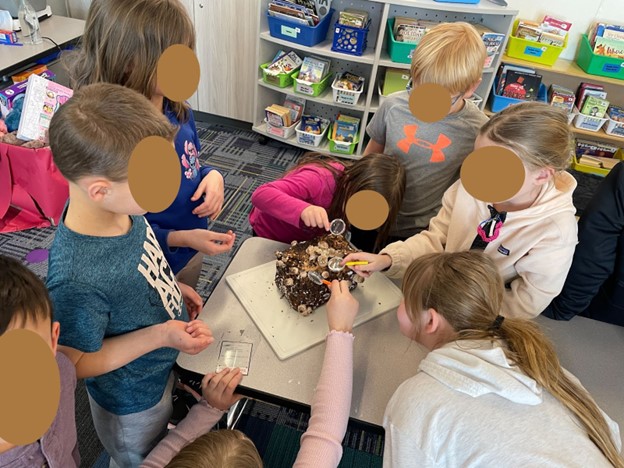
Second grade students gathered around a block of mushrooms and observing it with small magnifying glasses.
A Mushroom in Motion Stays in Motion!
A week later, I returned to continue our investigation. Using our dance, students quickly recalled mushroom parts—soon I was surrounded by dancing mushrooms calling out “cap!” and “gills!”
We then acted out the mushroom life cycle, from spores drifting through the air to growing and releasing new spores. Afterward, we revisited our predictions. Some had expected instant growth, others imagined towering mushrooms. In reality, some did grow quickly—but none reached the ceiling!
Finally, students harvested mushrooms to create spore prints. Though spores are too small to see individually, the prints revealed intricate patterns. By the end, these students had become mycologists, dancers, and artists—each taking home a unique spore print as a reminder of their mushroom experiments.
A fun(gi) bonus
For those of you who want to make your own spore prints at home, its super easy! Just follow these instructions below:
- Gather print items:
- Plastic cup or small bin
- Construction paper (light and dark colors)
- A flat surface to work on
- Harvest your mushrooms! You can source from the grocery store or outside.
- Kids: ask an adult before touching wild mushrooms.
- Adults: check a guide to make sure it’s safe to handle.
- Ray township library: https://share.google/Xb0XvyBRuDZ5ZS7PX
- USDA: https://www.fs.usda.gov/nrs/pubs/gtr/gtr_nrs79.pdf
- Choose the color of your print background:
- Light gills → dark paper
- Dark gills → white or light paper
- Prep for printing:
- Gently twist off the stem so the gills stay intact.
- Create the print:
- Place the cap gills-down on the paper.
- Cover it with a cup or bin so it isn’t disturbed.
- You do not need to press or flatten the cap, just gently place it on the paper.
- Make sure that whichever you choose, the container is large enough to sit flush against the surface of the paper or table without touching the mushroom cap.
- Wait for 5-12 hours
- Reveal your print
- Carefully lift the cup and mushroom cap…
- Ta-da! Your spore print appears!
________________________________________________________________________________
Hannah Rothkopf is a M.Sc. student in the Kozackiewicz Lab at the W. K. Kellogg Biological Station and a 2025-26 science education and outreach fellow. She studies how the severity and prevalence of wildlife disease varies across different host species and their environments. To do this she focuses on a fungal disease specific to snakes that has been found in Michigan’s only native rattlesnake, the endangered Eastern Massasauga rattlesnake.
A legacy of conservation; a commitment to sustainability.
Kellogg Bird Sanctuary12685 East C Avenue
Augusta, MI 49012
Phone: (269) 671-2510 birdsanctuary@kbs.msu.edu