
If you’re anything like me, spring is your favorite season and it’s not even close. We’ve made it through another long, dark winter, and now we’re rewarded with the sun sticking around a little longer each day. The crisp morning air makes a cup of coffee that much better, and the sun warms up enough by the afternoon to break out the shorts and T-shirts. Blooming flowers and singing birds signal that nature is waking up from its cold slumber, but personally, winter’s not officially over until I see my first turtle of the year.
Heating Up
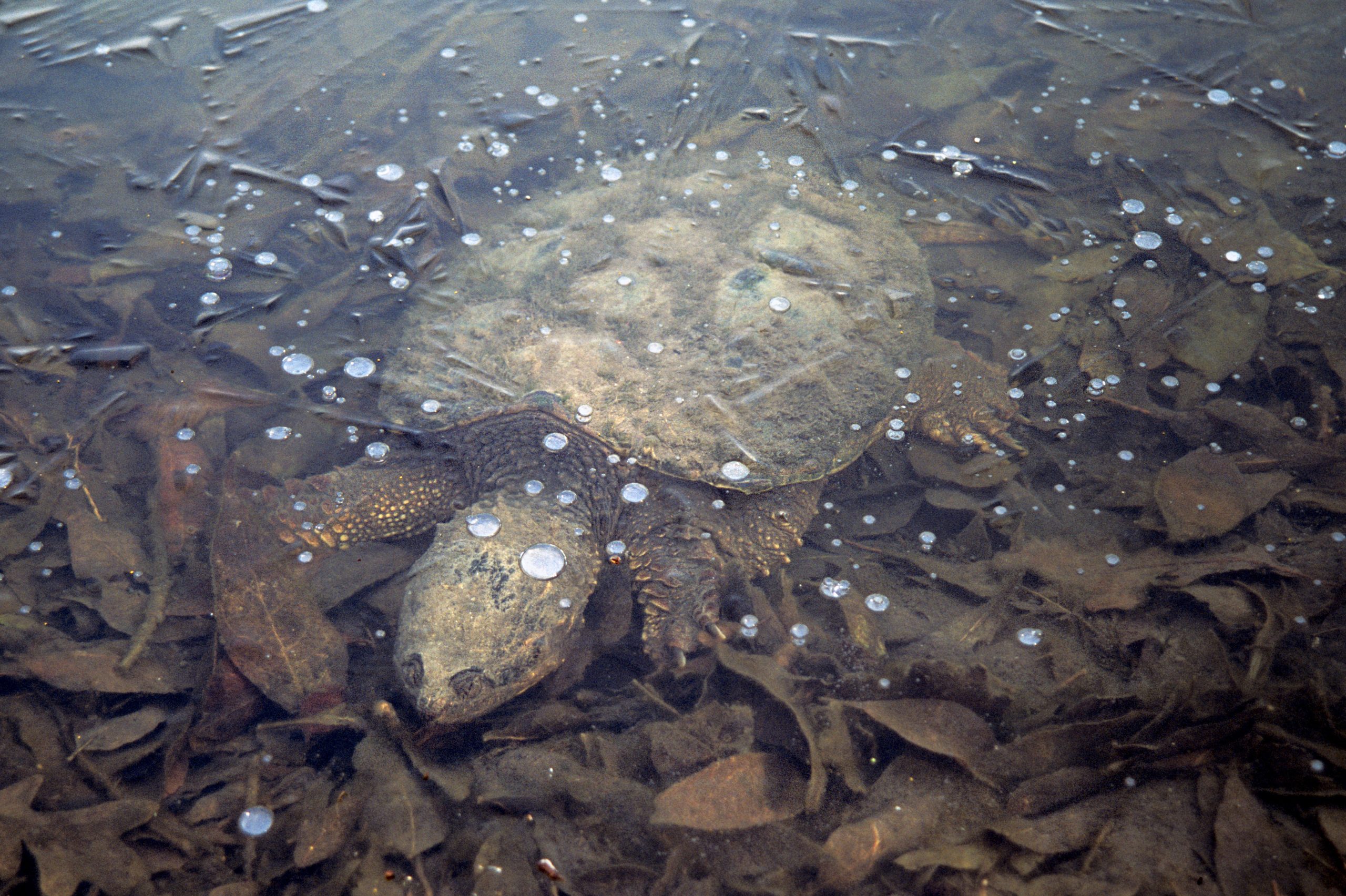
A snapping turtle swimming slowly under a sheet of ice
During the cold winter months, most of our turtles in Michigan hunker down in the muddy bottoms of streams and ponds. They aren’t technically hibernating and entering a sort of deep sleep like bears or squirrels though. Instead, because they’re ectotherms or “cold blooded”, they stay awake but slow waaaaaay down as their body temperature drops. Sometimes, if you’re lucky in early spring, you can find turtles crawling along the bottom of a pond under thick layers of clear ice, proving that they’re still awake despite the cold. As that ice melts and the water warms, the turtles start moving around more and more, and once the air is finally warm enough, they’ll haul themselves out of the water to bask for the first time in months. Early in the year, this basking helps them clear out a chemical called lactic acid, which is the same stuff that makes your muscles sore after a workout. After being stuck underwater for months, I bet basking feels absolutely heavenly. Plus, it’s usually how I see my first turtle each year!
Priorities
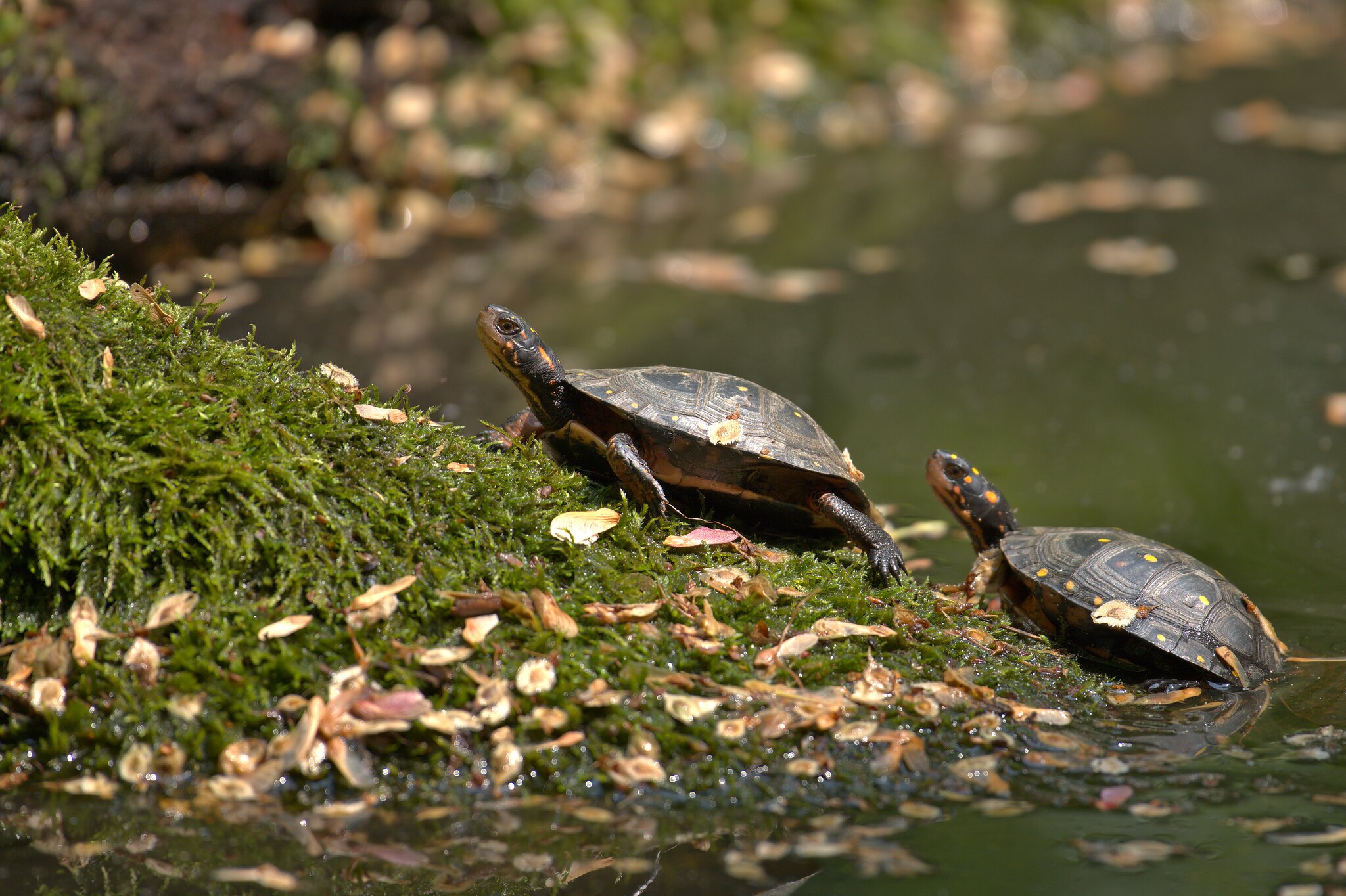
A pair of spotted turtles basking
Once things really start to warm up, turtles have about 2 things on their mind: eating and mating. Warmer temperatures mean turtle metabolisms are ramping up, and after fasting all winter, they are ravenous. Finding a good source of food in the spring might involve leaving their winter pond, which is one of the reasons you see turtles crossing roads this time of year. A lot of turtles end up eating all the other things that emerge in the spring, like aquatic insects and amphibians. Spotted turtles, the species I study, have a taste for wood frog eggs, so they gather in the ponds where the frogs breed to fill up. While they’re at it, males also get into tussles with one another and pursue females relentlessly, while the females, for their part, are mostly just trying to eat as much as possible to make eggs. I should point out, too, that “warm” is a relative term. I’ve seen spotted turtles and Blanding’s turtles mating when there’s fresh snow on the ground and the water temperature is barely above freezing!
Nesting
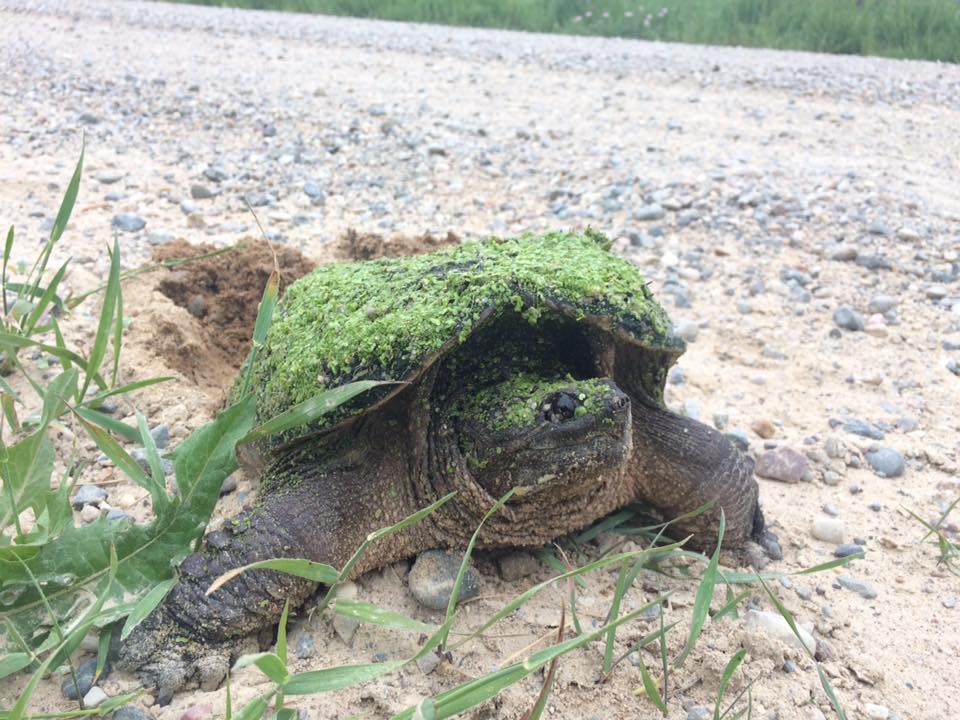
A female snapping turtle digging a nest
By about late May to early June, female turtles in Michigan have had enough time to make a clutch of eggs, which I bet feels incredibly cramped in their hard shells. To get some relief, they need to find a nice sunny patch of ground for their nest, which often means crossing roads – or even nesting right on the shoulder of one. This is one of the most dangerous times to be a turtle. In colder climates like Michigan, female turtles are fortunate because they only have time to nest once a year, but farther south, they might nest up to 4 or 5 times! That’s a lot of work and a lot of risk. However, once they’ve laid their eggs and covered them up, their parental duties are done. For the most part, they return to their local pond or stream and spend the rest of the year eating and basking until winter comes around again.
How to Help
So you’ve found a turtle crossing the road. Odds are high that it’s a female looking for a spot to nest, which means that turtle is at least around 10 years old. To put that another way, it would take about a decade to replace that turtle if it gets smushed by a car. That’s quite a while for the population to recover, which is why #EveryTurtleCounts and it’s an awesome idea to help turtles cross roads safely! Just follow these steps:
- Pull over safely and turn on your hazard lights.
- Grab the turtle by its sides with both hands and move it in the direction it was crossing.
- If it’s a snapping turtle, grab it by the back of the shell, nudge it along with a stick, or drag it on a car mat. Do NOT lift it by the tail!
- Put the turtle in the vegetation a few feet from the road. It knows what it’s doing and can take it from there.
Want to learn more about turtles? Sign up for our Turtles and Watercolors event on May 21st to practice painting with watercolors and learn more about our native turtles. All month long, you can bring your family to the Kellogg Bird Sanctuary and check out May’s storybook walk featuring The Magpie and the Turtle. You can also get hands-on with native turtles at our Exploring with Scientists: Turtle Adventures! event on June 6th, or visit the Sanctuary and walk around Wintergreen Lake to find turtles basking or moving on land to nest!
~~~~~~~~
Caleb Krueger is a Ph.D. student in the Janzen Lab at the W. K. Kellogg Biological Station and a 2025-26 science education and outreach fellow. He studies the endangered spotted turtle to improve conservation and management efforts, and he also studies the evolution of sex-determining mechanisms in reptiles, where incubation temperatures often determine whether eggs produce males or females.
A legacy of conservation; a commitment to sustainability.
Kellogg Bird Sanctuary12685 East C Avenue
Augusta, MI 49012
Phone: (269) 671-2510 birdsanctuary@kbs.msu.edu